

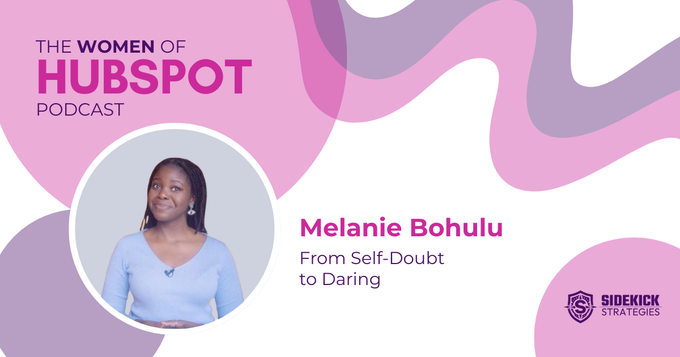
Melanie Bohulu shows up to this conversation with a question most of us run from: what would change if you stopped trying to make sense for everyone else and started trusting your own gut?
Every now and then I sit down for an episode of Women of HubSpot and walk away feeling like I just took a master class in self-awareness disguised as a podcast. This one with Melanie Bohulu was that kind of conversation.
Melanie is an Inbound Professor at HubSpot, a customer education obsessive, a percussionist who plays the London Latin music scene on the side, and (as she calls herself) a recovering Dutch speaker. She is also one of those humans who has done the slow, quiet work of figuring out who she is, what fills her cup, and what she refuses to negotiate on anymore.
She brought all of that with her, and it shows up in every answer.
If you've ever wondered whether you're too multifaceted for one career, too "in your head" to lead, or too busy apologizing for who you are to step into who you could be, Melanie's story is going to land. Here's what she taught me about confidence, communication, empowerment, and the kind of success that has nothing to do with a job title.
1. From Doubting Melanie to Daring Melanie
I opened the conversation with my favorite first question on this show: if you could go back in time and meet your younger self, what would she be most surprised about?
Melanie didn't reach for accomplishments. She reached for posture.
She said young Melanie would be proud, because young Melanie spent a lot of time doubting herself. She knew there was potential in there somewhere. She just couldn't pin down where it lived or how to share it. Today's Melanie is the one who finally figured out how to use what she was given. Her own one-line summary of the journey was so clean I almost wrote it down twice: more daring, less doubting.
That's the arc. That's the whole thing.
And here's the part I want you to sit with for a second. Most of us think "becoming more daring" looks like a big external event. A promotion. A book deal. A speech on a stage at INBOUND in front of 10,000 humans. Melanie reframes it as an internal shift. The daring isn't in what you go and do. It's in what you stop apologizing for first. Once you stop trying to convince every room you walk into that you make sense, you've got a lot of energy left to actually use your gifts.
For anyone reading this who is the quiet expert in their company, the HubSpot admin who knows the portal better than anyone but never speaks up in the leadership meeting, the marketing manager with the strategic instinct nobody asks for, that's your sentence too. Less doubting. More daring. The skills are already there. The portal already runs because of you. The systems already work because you built them. The question isn't whether you're ready. The question is whether you're going to keep waiting for someone to hand you a microphone before you trust your own voice.
“More daring, less doubting.”
That's the kind of permission slip a lot of us were waiting for.
If that arc lands for you, Brenna Zenaty's episode on saying yes to scary growth hits the same nerve from a different angle.
2. The Multipotential Mind and the Cost of "Making Sense" for Other People
When I asked Melanie about her mentors, she made the most interesting move. She didn't pull from her industry. She pulled from her life.
Her first answer was Rubén Blades. The Panamanian salsa singer. Who is also an actor, an activist, a lawyer, a former government minister. A human who refuses to live inside one professional box. Melanie said she gravitated toward him because she's interested in too many things to ever look "logical" on paper. For most of her life she struggled with that. She felt like she had to justify the connections between her interests because the world wouldn't accept her without that justification. Watching someone like Blades just exist as a multi-disciplinary human, doing whatever felt true, was a kind of permission.
Her second answer was her mom and her sisters.
Different personalities, she said, but one shared trait that runs through all of them. They do not compromise. They are extremely clear about their vision. They know what they want. And they do not negotiate.
That phrase stuck with me. They do not negotiate.
If you're listening for the lesson here, this is it. There's a difference between flexibility and self-abandonment. A lot of high-performing humans (especially women in tech, but honestly, anyone who grew up being told to "be agreeable") are taught to negotiate themselves into something smaller so the people around them stay comfortable. Melanie watched the women in her family refuse to play that game. They held their line. They held their vision. They were warm, but they were not for sale.
She named the trap directly. For most of her life, she felt an obligation to make sense to people while she was still trying to figure herself out. So she over-apologized. She over-explained. She over-justified. And in the process, she lost pieces of what made her, her. The breakthrough wasn't a single big moment. It was a slow recognition that she's an evolving human, that the people she's talking to are also evolving humans, and that they're going to act based on whatever version of her they happen to perceive in that moment. Her job isn't to control their perception. Her job is to respond to what's in front of her based on who she actually is.
That's a hard pivot. It also might be the most expensive lesson any of us ever learn.
The reason this matters for anyone who works in HubSpot, runs an agency, or carries a team isn't theoretical. It's operational. The humans who over-apologize for their expertise are the same humans who get talked over in strategy meetings. The humans who over-explain their decisions are the same humans whose teams quietly stop trusting them. And the humans who over-justify their work end up exhausted, because every conversation becomes a defense.
Melanie's move out of that pattern is a model. Notice the reflex. Ask whether you actually owe this person an explanation. Decide who you are before you walk into the room. Then walk in.
There's a quieter business lesson buried in this too, and it shows up the moment you start managing a team or running an agency. If you over-apologize and over-explain yourself, that posture infects everything downstream. Your project plans get padded with disclaimers. Your client emails open with three sentences of throat-clearing before the actual point. Your discovery calls turn into auditions instead of conversations. Customers can feel the difference between a partner who knows who they are and a vendor still trying to earn the right to be in the room. Melanie's mom-and-sisters lesson, "they do not negotiate," lands hardest right there. Negotiating against your own value is the first negotiation to stop having.
3. Demystifying the Hard Moments at Work
Of course, none of that internal work happens in a clean room. It happens at work, where humans misread each other, where bias is real, where you sometimes feel underestimated and you can't always tell if you're imagining it.
I asked Melanie if she'd ever felt overlooked or out of place in her career, and she did the rarest thing in this conversation. She didn't pick a side. She didn't say "yes, absolutely, and here are the villains." She didn't say "no, never, I powered through." She said both can be true at the same time, and the work is in telling them apart.
Her actual process when she feels overlooked is something every operator should write down:
- Pause and ask whether there's evidence. Have you been told something? Have you observed a pattern? Or is this a feeling you're projecting onto a situation?
- If there's evidence, decide how to respond while preserving your integrity and not compromising your value.
- If it's projection, name that too. Your brain is good at flagging danger that isn't really there. Insecurity will hijack a neutral situation if you let it.
- When the issue is real, treat it as a communication problem first. Break the situation down. Ask the other person to walk you through what they were thinking. Make space to demystify it before it builds into something it doesn't have to be.
- And here's the boundary line: if there's no room for that conversation, withdraw. Cleanly. Don't feed the situation. If it has to live, it lives somewhere else, with other people. That's not your project to carry.
Read that one more time, because that fifth point is the move most of us never give ourselves permission to make. We stay in the room. We argue back. We try to convert the misunderstanding through sheer effort. Melanie's posture is different. She's willing to do the work of demystifying, and she's willing to walk away from the work when the other person isn't.
That is grown-up emotional intelligence. That is also a real leadership skill.
“Trust your gut. Like your gut has no business in lying to you. Trust it.”
If that line resonated, Justine Gaignard's episode on trusting your gut and building confidence is the natural next listen on this show.
Her gut, by the way, has been right enough times that she's stopped arguing with it. When I asked about her biggest setbacks, she said the lesson every time was the same. She should have listened to herself. And the beautiful thing about life, she added, is that when you miss the lesson, life will just keep teaching it until you get it. You either learn now, or you learn later. You don't actually get to opt out.
For HubSpot admins, marketing leaders, and ops folks reading this, that posture changes things. Your gut about that workflow is probably right. Your gut about that data hygiene problem is probably right. Your gut about which team member is silently drowning is probably right. The thing that gets in the way is the same thing Melanie kept running into: the urge to over-justify yourself before you trust what you already know.
Here's where the practical and the personal collide. The five-step pattern Melanie walks through is basically a discovery framework wearing different clothes. Pause and gather evidence. Decide whether what you're seeing is real or projected. Address the real stuff. Demystify before you escalate. Withdraw cleanly when the conversation has nowhere to go. Swap "Melanie at HubSpot" for "you on a Tuesday standup with your team" and the same five moves still work. The same five moves also work when you're sitting across from a prospect who keeps shifting the goalposts, or a stakeholder who keeps saying yes in the meeting and no in their actions. Demystify what you can. Walk when you can't. Don't carry what isn't yours to carry.
4. Empowerment as a Full Cup, and the Abundance That Comes With It
When I asked Melanie what empowerment means to her, she paused. Then she gave one of the most complete answers I've ever heard on this show.
She started with self-awareness. You can only be powerful if you know who you are. And knowing who you are isn't a one-time check-the-box exercise. It's a muscle. You work it. You revisit it. You don't get to coast on the version of yourself you figured out three years ago.
Then she moved to the cup metaphor. Empowerment, she said, means doing the things that fill your cup, so that when humans around you need what you carry, you can pour without going dry. You can't pour from an empty cup. That sentence is everywhere right now, but the way she said it made it feel new. The implication isn't "rest more." The implication is "know yourself well enough to know what fills you, and then go do those things on purpose."
Then she said something I want to hand to every human reading this who has ever felt like they had to ration what they had.
There's food and drink for everyone.
It's something her mom says. It's a posture toward abundance. Whatever you carry, whatever your gift is, it's worth sharing, and there's enough of it to go around. You don't have to gatekeep your expertise. You don't have to operate from scarcity. You don't have to be afraid that helping someone else means you're going to be left with less.
For an agency owner, a service team lead, or a HubSpot consultant, that's a worldview shift. Most of us were taught that knowledge is leverage. Hoarding it feels safe. Melanie's frame, and ours at Sidekick honestly, is the opposite. Growth should be shared, not gate-kept. Pour the cup. Give away the playbook. The humans who needed more than the playbook will remember who poured it first.
Melanie tied this back to her Christian faith, gently, the way her whole posture is gentle. She talked about the fruit of the spirit, the conviction that she was put here on purpose, with a toolkit, for a reason. That belief is its own kind of empowerment. Not loud. Not preachy. Just steady. The peace of knowing you weren't a mistake and you weren't sent into your life without what you needed to actually live it.
“There's food and drink for everyone.”
That belief is what makes the next part of her story possible.
I'll add one more layer here, because I don't want this section to read like a feel-good aside. The "full cup, abundant pour" frame is actually one of the most under-rated leadership operating systems in business. The agency owners I know who burn out are almost always running on an empty cup, pouring from reserves they don't have, secretly resenting the humans they're pouring into. The agency owners who flourish are usually the ones who decided early on that filling their cup is part of the job, not a luxury they get to once the quarter closes. Melanie's "do everything that can fill your cup" line isn't a wellness post. It's an operational guardrail. If you can't name the three things that fill yours, that's a system gap. Fix it the same way you'd fix a broken workflow in HubSpot. Methodically. On purpose. With the same urgency you'd give to any other broken process.
For another angle on this same thread, Tracy Graziani's conversation on power, possibility, and building work that lets humans flourish is the companion episode.
5. Speaking Up Even When You Feel Like the Villain Might Get Unmasked
Melanie said the most rewarding part of her career has been getting handed a microphone.
Humans see her work, ask her to weigh in on something big, and trust that what she has to say is valuable. She still feels the impostor flicker. She described it in the funniest way possible. She said it's like the end of a Scooby-Doo episode, where the villain is about to get unmasked, and she's waiting for someone to pull off her face and announce that she's actually a fraud.
I think every human reading this has felt some version of that. The mic gets handed over. The room goes quiet. You can feel the moment where your imposter brain wants to scream "wrong person, you've got the wrong person." Melanie's not pretending she's evolved past it. She's just stopped letting it run the show.
She's also stopped waiting for permission to fill a gap. She described doing it more than once at HubSpot. She'd spot a need that nobody else had noticed, raise her hand, get met with doubt or silence (which she calls a polite way of saying "be quiet, Mel"), and then quietly go build something anyway. Not just a one-off fix. A solution that could scale. Whenever the self-doubt creeps back in, she reminds herself: you can do it again. You've done it before. Take two steps back, look at what you've already built, then move forward.
That's a discipline. It's also exactly what good HubSpot operators do. You see the gap nobody else sees. You build the workflow nobody asked you to build. You document the process so the team behind you has a playbook. And when someone hands you the microphone, you tell the truth about what you've shipped, instead of letting the impostor voice run the meeting.
If she could change one thing about how women are supported in this industry, she'd swap the support system for a structural change. Her line on this one was a punch. She said the whole reason we need so much "support" is that the system itself isn't supportive. If we actually believed in equality, in 2026 women shouldn't have to apologize for ambition or choose between being mothers and having careers. The conversation shouldn't be "how do we support women." The conversation should just be: support women. Point blank.
She's not wrong.
The structural point matters even if you don't run a Fortune 100. If you lead a HubSpot agency, you set the system inside your four walls. You decide whether the women on your team have to apologize for ambition, or whether ambition gets celebrated as the same kind of strength you'd celebrate from anyone else. You decide whether parental leave is treated as a normal season of work or a tax on a career path. You decide whether the assistant gets taken to lunch and the senior strategist gets ignored because of a story somebody learned 30 years ago. Every one of those choices is a structural choice. Every one of those choices is teaching your team what your culture actually believes, not what your culture deck says it believes. Melanie's call to "support women, point blank" is a call to stop performing inclusion and start engineering it.
On that structural-change thread, Dr. V Boykin's episode on choosing truth, building confidence, and helping humans flourish is the companion piece.
One more layer worth naming. Melanie casually mentioned that she's a percussionist who plays the London Latin music scene. She's an Inbound Professor who cut her workload 30 to 40 percent by integrating AI into her video editing and content workflows. She's, in her words, an open book about who she is. She does that on purpose. She refuses to be one-dimensional, because she knows the more of herself she lets show up, the more permission everyone around her has to do the same. That's leadership without a title. That's the kind of empowerment that doesn't need a microphone to spread. It just needs one human refusing to be smaller than she is, in front of other humans who needed permission to be the same.
6. Success Means Freedom
I closed the conversation with a fill-in-the-blank. Success to me means ______.
She didn't hesitate.
Freedom.
She left the definition of freedom open on purpose. Whatever it is in your life that you need to be free from, that's the freedom worth chasing. Maybe it's freedom from over-explaining yourself. Freedom from the version of you that doubted everything. Freedom from a job that doesn't fit. Freedom from a story you've been telling about who you're supposed to be. Freedom to write a list of dreams in 2010, like she did, and to keep checking boxes on that list a decade and a half later because you refuse to stop daring.
That's the through-line of Melanie's whole story. Less doubting, more daring. Less performing, more being. Less negotiation with your own gut, more trust in it. Less rationing your gifts, more pouring them.
It's also a frame I want to hand to every HubSpot admin, marketer, agency operator, and ops lead reading this article. The work we do doesn't have to be a tax on who we are. The systems we build don't have to overwhelm the humans they're supposed to support. The career you're building doesn't have to make sense to the loudest skeptic in the room. Build it anyway. Pour the cup. Trust your gut. Withdraw when withdrawal is the right move. Speak up when the mic gets handed over.
You're already daring. You just don't know it yet.
“Success to me means freedom.”
That one is going on the wall.
Reflect & Act
Take a few minutes with these. Don't just read them. Write your answers down somewhere you'll see them tomorrow.
- Where in your work are you still trying to "make sense" for someone else, and what would change if you stopped negotiating with your own gut about it?
- Which part of your story or skill set have you been rationing, and how can you start pouring it more generously this week, knowing there's food and drink for everyone?
- What does freedom actually mean for you right now, and what is one concrete step you can take in the next 7 days to move closer to it?
Connect with Melanie
Follow Melanie on LinkedIn to keep up with her work on customer education, instructional design, and the kind of leadership that refuses to negotiate against itself.