

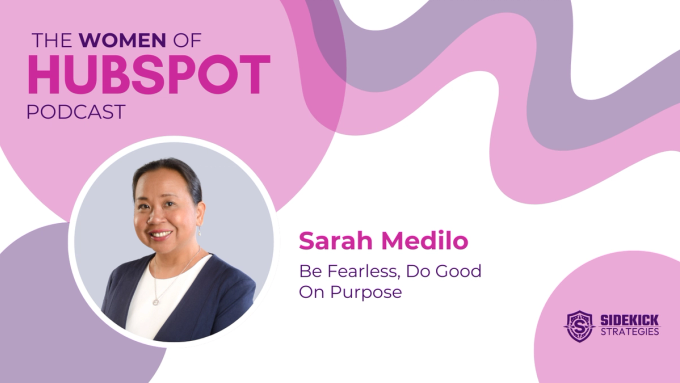
Sarah Medilo shows up with a worldview most of us would benefit from borrowing. Whatever life hands you, you get to decide whether to look at it as a gift or an opportunity. That decision is the one thing you actually control.
Every once in a while I sit down for a Women of HubSpot episode and the conversation refuses to stay inside the lines of "career podcast." This one with Sarah Medilo on LinkedIn was that kind of conversation.
Sarah is the RevOps Lead at Foundry for Good, a venture studio for mission-driven companies. She's a 20-year tech veteran across Apple, Adobe, and Autodesk. She led the top HubSpot Diamond partner in the Philippines. She sits on the HubSpot Solutions Partner Advisory Council. She helped stand up the HubSpot Partner User Group for South and Southeast Asia.
She's also a mother of three. A director of three Philippine nonprofits. A former ballerina with Ballet Philippines. A daily-prayer-and-meditation human whose entire operating system seems to run on one sentence: "Sarah, your goal today is to intentionally do good."
She brought all of it with her. The career arc, the caregiver pivot, the coaching frameworks, the fishing village overlooking the South China Sea where she's building her retirement home. And every answer she gave was anchored in the same belief.
If you've ever wondered how a human stays grounded while running global accounts at Apple, Sarah's story is going to land. She stepped back from a flourishing agency. She's helping mission-driven organizations grow. She's raising three kids on the other side of the world from the company that hired her.
Here's what she taught me about identity, pivots, empowerment, technology, and what success actually looks like when you stop chasing the endpoint.
1. The First Asian Guest, and Why That Moment Mattered
Sarah said something three minutes into the conversation that stopped me. She said it was an honor to be on the show because she believed she was the first guest from Asia. Twelve hours apart from me on the clock. A first voice for an audience that hadn't been represented yet.
She's right. And I appreciated that she named it directly instead of letting it pass.
The Women of HubSpot show exists because my daughter started talking about a college quarterback two years ago and a whole worldview cracked open for me about who gets the microphone and who doesn't. Sarah being the first Asian guest is not a footnote on this episode. It's the episode. The HubSpot community is global. The HubSpot Partner Advisory Council is global. The Diamond partner network is global. But the stories that get told most often are still concentrated in a few zip codes, and a 12-hour time-zone difference is enough to keep a brilliant human's perspective off most podcast feeds.
Sarah lives in Calatagan, near a fishing village overlooking the South China Sea. She was the first Asian guest. There will be a second, and a third, and a tenth, and that's because she said yes to being the first.
For any HubSpot admin, partner, or operator reading this from outside the usual gravitational center of the conversation, that's the invitation. Your story belongs in this network too. The room won't always know to make space for you. Sometimes you have to walk in and take the seat. Haydee Ferrufino's episode on building opportunity engines in El Salvador lives in the same conversation about who the HubSpot ecosystem is for.
2. From Political Science to Compaq Sales (the "I Thought I Didn't Like Sales" Turn)
Here's the thing about Sarah's career that I love: she didn't grow up dreaming about tech. She graduated with a BA in political science from Ateneo de Manila University. She thought she was going to build a law firm. Then she had her first child right out of college, needed a job, and walked into the IT industry by accident.
And she walked in convinced she did not want to do sales.
"I don't want to be in sales. I don't want to be in sales," she kept telling herself. Back in the 90s, sales meant the Electrolux man knocking on your door. Hard sell. Pushy. Everything she wasn't.
She took the job anyway. Sold Compaq computers. Then Compaq servers. Then she discovered something about herself.
“I thought I didn't like sales, but I loved sales. My secret sauce was really just the charm, building the relationship, listening to people, trying to understand what made them tick.”
Read that line again, because it's a whole career philosophy in two sentences. Sarah didn't fall in love with the transaction. She fell in love with the human. The deal-closing followed the listening.
Her biggest client back then was Jollibee. If you don't know Jollibee, it's the Philippine fast-food chain that's now global. The smiling red bee on the logo is there for a reason. Sarah's POs from Jollibee used to jam her fax machine for two hours at a time. That wasn't because she was running the slickest pitch deck in Manila. It was because she was building the relationship.
And here's the part for every HubSpot admin, every partner consultant, every RevOps lead reading this: that's still the model. The technology has changed three times since 1999. Compaq, dial-up cards, Apple, HubSpot, Breeze. The thing that closes the deal hasn't changed. Listen. Understand what makes them tick. Build the relationship. Earn the right to recommend the solution.
Sarah also did something else I want to name. She didn't stay in sales. She got curious about the products she was selling, so she became a product manager. She managed Zoom Internet (the dial-up card, not the video platform we live on now). She moved into product marketing. Then back into sales for a different employer. Then global strategic accounts. Each pivot was driven by the same instinct: she wanted to see the next picture. Sales taught her the human. Product marketing taught her the why. Strategic accounts taught her the scale.
If you're sitting in a role right now and you keep asking yourself "should I jump to the next thing," Sarah's answer is in her own resume. The pivot is not the threat. The pivot is the curriculum.
3. Apple, Tim Cook, and the Mentors Who Gave Her Autonomy at 27
Sarah ended up at Apple. Specifically, at Apple Southeast Asia, on the team handling the rest of Southeast Asia (or ROSA, as they called it internally). She was running strategic accounts across 16 countries.
And yes, she dropped this casually about 10 minutes in: she was in war rooms with Tim Cook. He's on her iChat.
That's a flex. She owned it. We moved on. (I asked.)
But here's where the conversation got rich. When I asked Sarah about her mentors, she did not pull from headlines or LinkedIn-famous executives. She pulled from her actual life. She named two humans who built her.
The first was Mona Chua, her first boss at the Compaq days. Mona's not in tech anymore. She runs a Chinese food shop now. But Mona taught Sarah the basics that you cannot pivot your way around. Work ethic. Being on time. Doing the cold calls. Walking the buildings with the directory in hand, deciding who you were going to talk to. The unglamorous fundamentals. Sarah admits she wasn't the perfect employee at 20. She'd go play billiards the night before with friends. Mona would show up and say, "Where's Sarah?" The discipline got built one accountability moment at a time.
The second was Gerard Chua, her boss at Apple. Gerard is now at Microsoft. He's the human who, when Sarah was 26 or 27, nominated her to speak at one of their global sales rallies on lighthouse accounts. Picture that for a second. A 27-year-old Filipina, in front of the entire regional sales org, talking about strategic accounts.
“[Gerard] gave me autonomy to create the relationships that I needed to build the right accounts for the countries that we serve. He allowed me to shine at such a young age.”
That's the leadership move I want you to put on your wall if you manage humans. The biggest gift a leader can give a young high-potential teammate isn't praise. It's autonomy. The room to build, the room to be seen, the room to stand at a microphone before they're 100 percent sure they belong there.
Sarah did belong there. Gerard saw it. The rest of the room caught up.
If you lead a HubSpot agency, a RevOps team, a content org, whatever it is, ask yourself: who on my team needs me to be their Gerard right now? Who is the 27-year-old version of Sarah on my roster, and am I giving them the autonomy and the microphone or am I holding them back because I'm not ready to share the spotlight? Tracy Graziani's episode on power, possibility, and building work that lets humans flourish sits right alongside this idea from a different angle.
The talent on your team will rise to the height of the ceiling you build over them.
4. The Caregiver Pivot: Letting Go of the Agency to Be With Her Mom
This is the part of the conversation that broke me open a little.
Two years ago, Sarah let go of the company she had built. She had led the agency to Diamond partner status in under two years. She had employees who were happy, clients who loved the work, an entrepreneurial career arc that most humans would consider the destination.
Her mom has Alzheimer's. Late stage.
Sarah's husband sat her down and said, plainly, "Your mom's not going to be here for so long. And you're not even there. You're not even there."
The agency was a 24/7 job. Sarah was activating other family members to cover for the time she couldn't give her mother. So she handed the company to her business partner, stepped back, and made one of the most expensive decisions of her career on purpose.
“I had to give that company up two years ago. It was a big hit on my ego because I felt like I had to stop everything. But I knew I was doing it for something that was very important to me.”
If you've ever made a hard call like this one, that line lands different. The ego hit is real. The career-narrative whiplash is real. The "but I was supposed to be the entrepreneur" voice in your head is real. And Sarah named it without dressing it up.
She did not stay still. Sarah is, in her own words, an activator. She took a RevOps role at Security Bank, one of the top trade and wealth banks in the Philippines. Hybrid setup, good benefits, time with her mom. She thought she was going to be a banker for the next chapter.
Then the founder of Foundry for Good slid into her LinkedIn. Sarah said no the first time. She was happy at the bank. But during Holy Week last year, the message resurfaced. She went and read about Foundry for Good. Venture capital, but for businesses that serve the mission-driven sector. Nonprofits, healthcare, education, faith-based organizations. The humans who serve other humans.
She knew immediately. Sarah is already a director for three Philippine nonprofits. Teach Peace Build Peace Movement (peace-building work). One Portrait (a photography program where kids in far-flung areas of the Philippines learn to take pictures and then exhibit their work in their own communities). Classroom Sang Pag-asa, which builds classrooms in the remotest parts of the Philippines.
Foundry for Good wasn't a job. It was the alignment her resume had been pointing at for years. She took it. Work from home. Split shifts so she can build during Manila mornings while Atlanta is sleeping, then talk to humans in the evening when the US is awake. Family time intact. Mom time intact. Three nonprofits still in motion. Mission-driven companies getting the systems they need to flourish.
Here's the lesson buried in this section, and it's for every operator reading this who's white-knuckling a career arc that no longer fits. The pivot is not the failure. The refusal to pivot is the failure. Sarah's ego took a hit. Her identity wobbled. She stepped through it anyway. And what came out the other side was a life that integrates rather than competes. Anne McDonnell's episode on career pivots and honest leadership is the next conversation to sit with if this is the season you're in.
You do not have to keep climbing the ladder you were climbing in 2019. You're allowed to climb a different one.
5. The Empowerment Toolkit: Listen First, Coach Second, Forgive Always
When I asked Sarah what empowerment means to her, she didn't talk about programs or pipelines or initiatives. She talked about listening.
Specifically, listening first. Giving humans the space to be clear about where they want to go and what impact they want to bring. Resisting the reflex (the same reflex she catches in herself as a mother of three) to direct everyone toward your map of their life.
She has built an actual toolkit around this. Sarah is a Gallup Certified Strengths Coach. She's a Positive Intelligence Coach. She practices Nonviolent Communication. Three different frameworks, three different lenses, one shared insight: most of the time, what humans need from you isn't your answer. It's your full attention.
Listen first, she says. Give space for people to be clear about where they want to go.
For any HubSpot admin who's ever sat in a discovery call ready to recommend the solution before the prospect finished their sentence, that's a reset button. For any agency owner who keeps "fixing" their team members instead of asking them what they're actually trying to build, that's a reset button. For any RevOps lead who walks into a portal and starts moving things around before understanding why the previous admin built it the way they built it, that's a reset button.
Sarah's daily mantra is the operating system underneath all of it. She starts every day with prayer and meditation. Then she tells herself one line.
“I start my day with prayer. I meditate and tell myself, 'Sarah, your goal today is to intentionally do good.' And that has been my mantra.”
Intentionally do good. Two words doing all the heavy lifting in that sentence. Intentionally means on purpose, by design, with awareness. Not "if I happen to have time." Not "if the day goes my way." On purpose. Do good means the assignment is clear before the day even starts. You're not here to win. You're not here to optimize. You're here to do good, and the rest is downstream of that.
The other piece Sarah said that I want every leader to sit with: forgive yourself when you slip. She told a story about realizing she was about to miss a deadline because she'd forgotten about it. Old Sarah would have spiraled. Today's Sarah took a breath, told herself "you still have time," and got it done. Because she remembered, in the moment, that mistakes don't disqualify you. They strengthen you. Grace is part of the operating system, not a bug in it.
That's the empowerment frame. Listen first. Coach second. Forgive always. Show up on purpose to do good, one day at a time. Lica Wouters' episode on human-centered ops carries the same operating philosophy into the day-to-day of how a HubSpot portal actually gets built.
6. Technology Is the Amplifier, Humans Are the Purpose
I had to ask the HubSpot question, because, well, it's the Women of HubSpot show. So I asked Sarah what's exciting her right now in the platform.
Her answer was layered. When she took her career break and went to the bank, she was running Salesforce. She wasn't touching HubSpot at all. When she came back to the ecosystem last year for Foundry for Good, she walked into a different world. AI was everywhere. Breeze assistants and Breeze agents. Agentic workflows.
Sarah works across a minimum of 10 to 15 portals at any given time. She physically cannot do her job without setting up assistants and agents to multiply her own bandwidth. She's geeking out on what they can do, and she's listening to Casey's Another Orange Morning to keep her finger on the agentic-workflow conversation. (Cheers to Casey on that one.)
But here's the move Sarah made that I want you to copy. She did not talk about the technology as if it were the point.
“Technology will always shift. When we're thinking about how do I intentionally use these systems, these technologies, then we can actually turn them to amplifiers for the good.”
Amplifiers for the good. That's the frame. The Breeze agents are not the goal. The 10 to 15 portals are not the goal. The agentic workflows are not the goal. The humans behind those portals, the mission-driven organizations Foundry for Good supports, the nonprofits that finally get the operational infrastructure they need to scale their impact, those are the goal.
If you're a HubSpot admin sitting on the fence about AI, Sarah's frame is your permission slip and your guardrail at the same time. Garbage in, garbage out. Set the foundations. Give the AI context. Set the guardrails. Then aim it at something that matters, and let it amplify your ability to do good. If you want help getting the foundations right, Sidekick's AI consulting is where this conversation goes from frame to system.
The technology is the amplifier. The human is the purpose. Don't flip that order.
7. Be Fearless: Look at Whatever Life Hands You as a Gift or an Opportunity
I gave Sarah the magic-wand question near the end. If you could change one thing about how women are supported in this industry, what would it be?
She called her own answer a hot take. Then she delivered the line that's going on my wall. (If "be fearless" is the muscle you're trying to build right now, Melanie Bohulu's episode on the move from self-doubt to daring is the next conversation queued up.)
“I'd like our viewers to be fearless. Because things will happen in our lives, the one thing that you control is the fact that only you can look at things so that whatever comes into your life, you look at it in a lens that this can be a gift or an opportunity.”
Read that one twice.
Sarah is not saying "be fearless" as a slogan. She's saying it as a frame of control. The world will hand you what it hands you. Most of it, you do not get to choose. The economy, the layoff, the diagnosis, the move, the breakup, the unexpected door slammed shut. None of that is in your control.
The lens is in your control.
You get to decide whether the thing you're staring at right now is a setback or a setup. Whether the layoff is a loss or a launch ramp. Whether the diagnosis is the end of the chapter or the beginning of a different one. Sarah lived this when she let go of her agency. The ego said failure. The lens said purpose. She chose the lens. Then she built a different life around the choice.
That's also why she frames success the way she does. I closed the conversation with the fill-in-the-blank we ask everyone. Success to you means ______.
She wouldn't put a destination on it. Success is not an endpoint, she said. It's something you're journeying toward.
Success, in Sarah's lens, is the future. It's bright when you see things as gifts and opportunities. There will be happy moments. There will be sad moments. At the end of any given day, when you're living fully, learning from the humans you meet, present with the family in front of you, you're already successful. The endpoint is a myth. The journey is the thing.
If you're chasing a number, a title, a milestone, a square on a LinkedIn banner, Sarah's answer is the gentle disruption you needed today. Pick the lens. Stay present. Do good. The rest is downstream.
One more curveball before we wrapped. I asked Sarah the surprising-fact question. She had hinted at being in war rooms with Tim Cook. I was waiting for her to tell me she'd also been an astronaut. (Honestly, I was bracing for it.) What she dropped was different.
In high school, Sarah danced for Ballet Philippines.
She'd been a ballerina. That's how she's raising her kids, too. Give them every experience you can. Let them try the things. Let them discover where their talent and their growth actually live. Don't escape life. Experience it.
That's the through-line of everything Sarah said for 38 minutes. Don't escape life. Experience it. Pick the lens. Listen first. Coach the humans in front of you. Use the technology as an amplifier, not a master. Step back when family needs you. Step forward when purpose calls. Build the retirement house overlooking the South China Sea on purpose, because peace is not a side effect of a successful career. Peace is a decision you make every day, alongside the work.
Reflect & Act
Take a few minutes with these. Don't just read them. Write your answers down somewhere you'll see them tomorrow.
- What's one thing in your life right now that you've been framing as a setback, and what would change if you decided, on purpose, to look at it as a gift or an opportunity instead?
- Who is the Mona or the Gerard in your career story? The human who taught you the fundamentals, or gave you autonomy before you thought you were ready. Have you told them lately what that meant to you?
- If you wrote Sarah's mantra in your own voice, what would it say? Fill in this blank for yourself: "[Your name], your goal today is to intentionally ______."
Connect with Sarah
Follow Sarah Medilo on LinkedIn to keep up with her work at Foundry for Good and her mission-driven HubSpot portfolio. She leads with listening as the first move and good as the daily assignment.


