


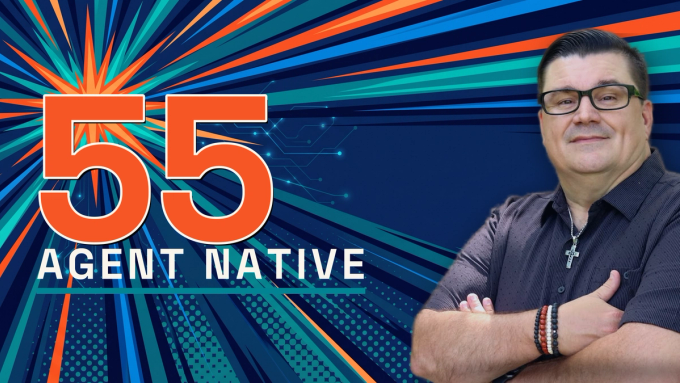
Today I turn 55.
I'm not writing this to throw myself a party. A birthday is just a little hill. You climb up, you catch your breath, and for a second you can see back down the road you came in on. If you turn around and squint, you can see a bit of where the road is headed too.
So let me stand on the hill for a minute and tell you what I see. There's a quiet question that shows up on days like this, and it's not "how many candles." It's this one: am I becoming who I was meant to become?
That's the question I want to hand you. Not because I've got it figured out. I'm just a guy. But I've come to believe it might be the most important question any of us can ask right now, in a season when the machines are learning to do so much of what we used to call work.
Here's where I've landed after 55 trips around the sun. The humans who flourish alongside AI and agents won't be the ones who become more like the machines. They'll be the most human humans in the room. And they'll carry one superpower on top of that. They'll be agent native.
I want to talk about both. But the order matters, so don't rush past it. Human first. Then the superpower.
Where we come from
I was born in Canton, Ohio, on September 26, 1971. By the time I was three, my family was living in a one-room log cabin in Lincoln, Montana. When I say one room, I mean one room. No running water. Old logs, up in the mountains. My dad was a logger. We bathed in the river beside the cabin, because that was the bath we had.
I'll be honest with you about the story I used to tell myself about that. For a lot of years, somewhere around nine, ten, thirteen years old, I looked at those beginnings and I heard a voice say, "Man, you started out small. Your life is destined to be small. You're the son of a logger living in a one-room log cabin with no running water. Who are you ever going to become?"
But here's the thing about a coin. It has two sides.
There are also pictures of me riding the crap out of my big wheel in those mountains. Pictures of me standing next to a pine tree with the biggest smile you have ever seen. Around nine, I rode a pony to a one-room schoolhouse. And when I look back now, older me can see what younger me missed while he was busy feeling insignificant. I was enjoying the crap out of that life. I didn't care that it was half a room. I didn't care that there was no hot water.
I tell you that story for a reason, and it isn't nostalgia. That cabin taught me something before I had the words for it. When you don't have much, you notice people. You notice who shows up. You notice who shares. You notice who keeps their word, and who sits with you when it's hard. Our tools were simple back then, and the relationships did the heavy lifting.
That's still true today. The relationships still do the heavy lifting. The tools just got a whole lot louder.
And I'm actually grateful I started in that cabin. As big as the brand gets, as boisterous as I choose to be, I can always draw myself back to that quiet, salt-of-the-earth kid by the river. That's one of the things that keeps my ego at bay. Which, hold that thought, because the ego is going to come back around later in this story with a name.
So here's my first ask, and it's the whole foundation. Whatever technology shows up next, and it will, stay the most human human you know how to be. That's the starting line. Everything else is built on top of it.
We trained for everything except this
Let me ask you something, and I'm asking myself right alongside you.
Think about all the training you've done in your career. You've learned the software. You sat through the onboarding. You studied the frameworks, the playbooks, the best practices. I've earned more than 40 HubSpot certifications, and I'm proud of every single one. We are really, really good at training humans on tools and on business.
Now here's the question that stops me cold.
When did anybody train you to listen? To sit with someone's hard news without rushing in to fix it? To notice the actual human behind the email instead of the task in the email? To be fully present in a room when your phone is buzzing in your pocket like it owns you?
Most of us never got that training. We just assumed our humanity would take care of itself. That being human was a birthright, automatic, always on.
It isn't. Our humanity is a lot more like a muscle than a birthright. Left alone, it weakens. Hurry wears it down. Screens wear it down. Endless efficiency wears it down. And now, for the first time, we've got tools that can do so much of the doing that it would be easy to let the being quietly slip away and never notice it left.
So I'll say it plain, and it's the line I keep coming back to:
You're upgrading your tools every single month. How are you upgrading your heart?
That's the real question of this whole moment. Not "which model is best." Not "which app wins." The scarce thing isn't speed anymore. It isn't scale. When machines can do everything, the only thing left to differentiate on is the thing a machine can't be. Human.
How to know if you're drifting
Maybe you're reading this and thinking, "George, I'm a pretty human person. I care about people." And you probably do. I believe you.
But caring and showing up aren't always the same thing. So let's hold up a mirror together for a second. Not to make you feel guilty. Guilt is a lousy engine. Just to help you see clearly, because you can't fix what you won't look at.
Sit with these. Slow.
- When was the last time somebody walked away from a conversation with you feeling fully heard?
- When your phone lights up in the middle of a conversation, where do your eyes go? Be honest.
- Do you actually know the real stories of the people you work with every day, or just their job titles?
- When did you last say "I don't know," or "I was wrong," and mean it all the way down?
- When did you last feel something at work? Delight. Heartbreak. Wonder. Anything at all.
If you just had a wildly productive week and you can't name one single moment of real connection in it, that's not a failure. Don't beat yourself up. That's a signal. And signals are gifts, if we're willing to actually listen to them.
Now here's a braver way to run the diagnostic. Go to someone who loves you, someone who sees you up close, and ask them two questions. "When am I most myself? And when do I disappear?" Then, and this is the hard part, don't defend yourself. Don't explain. Just listen with your heart, not just your ears. Their answer will tell you more about where you're drifting than any assessment I could ever build for you.
And then you train. Small reps, every day. One unhurried conversation. Phone face-down when a human is talking to you, because you're telling them without words, "you matter more than whatever is glowing on this screen." One honest question you actually want the answer to. A note of thanks to somebody who will never expect it. A few quiet minutes to reflect before the day swallows you whole.
For me, a lot of that quiet is prayer. I'm on fire for Jesus, and I'm not going to swing that at you like a 2x4. That's not my way. I plant seeds, I don't beat people over the head. But I'd be lying to you if I left it out, because that's where my heart gets recalibrated when it drifts. Whatever your practice is, whatever refills your cup and re-centers your soul, guard it with everything you've got. Because that's the well the most human version of you is drawing from.
Which brings me to the superpower. Because here's the trap nobody warns you about. The tools are about to hand you a whole lot of time back. And time is exactly the thing that either makes you more human or lets you disappear faster.
What agent native actually means
Let's clear something up first, because there's a lot of noise around this word.
When I say agent native, I do not mean you've memorized a pile of prompt tricks. I don't mean you know every tool on the market. I mean you can do four things with some confidence:
- You can brief an agent clearly.
- You can set boundaries for it.
- You can orchestrate more than one piece of work at the same time.
- You can judge what comes back.
That's it. Brief, bound, orchestrate, judge. In plain English, the agents take the busywork and the first drafts, and you stay for the meaning, the relationships, and the decisions that go out into the world with your name on them.
And that last part is not a small thing. When something ships, you own it. Not the model. Not the vendor. Not "the AI." You. So the goal was never to hand over your judgment. The goal is to free up your time so you have more judgment to give, and more of yourself to spend on the humans who need it.
Here's the belief underneath all of it, and it's the belief that took me years to earn:
Human context first. Tools second.
Tools amplify whatever is already there. If there's clarity, they amplify clarity. If there's confusion, congratulations, you just built confusion at scale. An agent pointed at a shallow human produces shallow work faster. An agent pointed at a deep, clear, honest human produces something that actually carries a soul.
So the agents are going to give you hours back. Real hours. And the whole test of your life in this next season is one question: what will you pour those hours into? If you pour them back into more busywork, you've just traded one treadmill for a faster treadmill, and you'll be more tired at a higher speed. If you pour them into people, into presence, into the work that only you can do, that's the moment the superpower actually becomes super.
Building systems with agents (here's what I actually did)
I don't want to leave this at inspiration. Inspiration without application is just noise. So let me pull back the curtain and show you exactly how I've been living this, because there's no secret sauce here, and I'd rather you copy it than admire it.
For about a year and a half, closer to two now, I've been building something I call my main brain. Some days I call it Echo, because it's an echo of me. Most folks would call it a second brain. For me it became the center of how I work.
Here's the part that surprises people. I did not start with the tools.
I started by writing myself down.
1. Write your human down first
Before I gave a single agent a single task, I wrote down who I am. My beliefs. My voice. The stories I tell and why I tell them. The mindsets I try to lead with. How I want to show up for my clients, my friends, my family. And just as important, the lines I will not cross, no matter how good the shortcut looks.
I'll be straight with you. That was harder than any piece of technology I have ever learned. Writing yourself down means facing the gap between who you actually are and who you pretend to be. And there were days that a guy I call Geo wanted to write the impressive version of me instead of the honest one.
Geo is my ego. Years ago, before I was even cool enough to be George, people called me Geo, and he's still in there. He's the egotistical guy who wants to look good. So a big part of my daily work, quietly, is keeping Geo at bay so I can live as George. And I'm telling you, writing your human down is where that fight gets real. You cannot build an honest system on a dishonest self-portrait. I had to keep choosing the true version.
Once I had it written down, something wild became possible. I can right-click that identity, copy the path, and hand it to any agent I'm working with. Here's who I am. Here are the four cornerstones I live by. Here are my stories and how I show up. Here's my voice, here's what I believe, here's the timeline of my life. And the moment I share that, the agent intimately knows me. It's the closest thing I've seen to duplicating yourself.
Your first move: it isn't a tool. It's a page. Write your human down.
2. Give agents context and outcomes, not choreography
Only after the human layer existed did I start layering tools on top.
I built an agent team that works out of that brain. I've got a human in the loop, that's me. And then I've got agents with real roles. A COO. A project manager. A developer. I've built small agents of my own. I run an agent team with Grok Bot working from that same brain, and I use Claude Code to build things and, honestly, to keep learning. Some of my favorite weekends lately have been me in my chair, going back and forth with Claude Code, thinking, "this is so much fun."
But here's the mindset shift that made it click, and it's the one I want you to steal. I stopped handing agents step-by-step choreography, and I started handing them outcomes.
A feature, in this new world, is not a function somebody writes for you. A feature is an outcome you describe clearly, handed to an agent with the right tools, that it works toward in a loop until the outcome shows up. You're not writing the recipe anymore. You're describing the meal and standing in the kitchen to taste it.
None of those agents would be worth a thing without the human layer underneath. They'd just be fast and generic. Fast and generic is the booby prize. The human layer is what makes any of it worth reading, worth trusting, worth shipping.
3. The payoff is stuff you didn't design
Let me give you the moment this got real for me.
Before one particular weekend, my platform didn't have a courses section at all. So I sat down with my agent team, and I didn't tell it how to build anything. I told it who we're helping. I told it to think like a course creator, a coach, a pastor, a designer, a developer, all at once. I told it to look at my framework and think about people's pain points. It was a long, human, honest prompt.
And it came back with 21 courses we could build. Foundation, growth, transformation. It even built a little pricing structure, and on top of that it added an annual pricing toggle so someone could switch from monthly to yearly with one click.
Here's the line I keep telling people. I didn't build that toggle. It did that. It gave me something I didn't explicitly design for, because I'd given it enough of my context and a clear enough outcome that it could run past my own imagination.
That's the whole game. That is what agent native actually produces when you do the human work first. Not you, replaced. You, amplified past what you could reach on your own.
So don't use agents to avoid thinking. Use them so you can think about bigger things. Let them carry the load. Don't let them carry you.
The practices, so you can start Monday
You do not need two years and an agent team to begin. I promise. You need one honest page and a handful of habits. Here are the four I'd hand a friend over coffee.
Write your human down. What do you believe about your work? What does your voice sound like when you're at your absolute best? Which stories do you keep coming back to? What won't you do? Put it in a document you can hand to an agent before you ever ask it for a single thing. You will not believe how different the output feels when the machine actually knows who it's working for.
Brief with boundaries. A good brief is just a good conversation written down. Here's the goal. Here's who it's for. Here's what good looks like. Here's what to avoid. Here's what I want back, and when. If you'd hand it to a new teammate you cared about, hand it to an agent too.
Conduct instead of playing every instrument. This is the shift from player to conductor. Let one agent draft while another one researches while you're on a call with a human who actually needs your face and your full attention. Your attention is the scarce resource now. Point it where only you can go.
Keep judgment human. Read everything that comes back. Check the facts. Ask the four questions: Is it true? Is it kind? Does it sound like me? Does it serve the human on the other end? The agent did the draft. You decide what's true, what's kind, and what's ready to carry your name. That never gets outsourced. Not ever.
One thing for this week
Here's my birthday ask, and it's a small one, but don't let the size fool you.
This week, before you learn one more tool, sit with one question. Just this: "Am I the most human version of me right now?"
Then do the brave thing. Ask one person who loves you where they see you disappear. And don't defend yourself when they answer.
Then open a blank page. Title it with your name. And write down three things you believe about your work, one story that explains why you do it, and one line you will not cross. That's it. Don't polish it. Don't prompt anything yet.
That page is your starting line. Mine was a log cabin and a pony ride to a one-room schoolhouse. Yours might be a kitchen table with a kid's water cup that never made it to the dishwasher, or a cubicle, or a car in a parking lot in the fifteen minutes between meetings. It does not matter where you start. It matters that you start human.
Then, and only then, bring in the agents.
Fifty-five years in, that's what I know for sure. Train your heart like you've trained on your tools. Get agent native on purpose. And let the technology amplify the best of who you already are, instead of papering over who you never became.
Because the world does not need more efficient humans.
It needs more human ones.
I'm still a beginner at a lot of this. I break things. I rebuild them. Some days I break myself a little too, and I have to rebuild that as well. So wherever you are on this road, come on. There's room on the hill.
Now go write your human down.